
Log in


Desia Team
Product
October 9, 2025

Large language models (LLMs) are transforming many industries, but when it comes to financial documents, they fall short. In finance, accuracy defines trust. The fine print in regulatory filings, contracts, and reports drives valuations and due diligence outcomes. Yet these are exactly the materials most LLMs misread. Standard models handle clean PDFs, but struggle with charts, tables, and diagrams, breaking cell mappings, ignoring visuals, and missing links between data and context.
The challenge increases with non-searchable PDFs like scanned filings or legacy portfolio reports. These confuse text-only models, resulting in missing content and fragmented insights. In due diligence, even a misplaced figure or unread chart can change a valuation narrative.
Complex spreadsheet documents add further complexity. What matters isn’t just the output, but the logic - formulas, dependencies, and assumptions. Flattening a model into static text removes that intelligence, making it impossible to validate sensitivities or trace drivers.
The result: incomplete analysis, slower deal cycles, and decreased confidence in AI-driven workflows. That’s why leading funds and family offices are turning to purpose-built document parsing, designed to handle unstructured, high-stakes materials with the precision real investment work requires.
The Desia team has developed a comprehensive document parsing solution designed specifically for the challenges faced by finance professionals. Desia system combines Vision-Language Models (VLMs) with file-type specialization, ensuring every document, from VDRs and models to investor reports, is accurately understood, structured, and ready for analysis.
By combining VLM-powered extraction, contextual enrichment, and spreadsheet logic preservation, Desia delivers end-to-end parsing built for the real workflows of investment professionals. It accelerates due diligence, reduces manual review, and gives teams confidence in the integrity of AI-driven analysis.
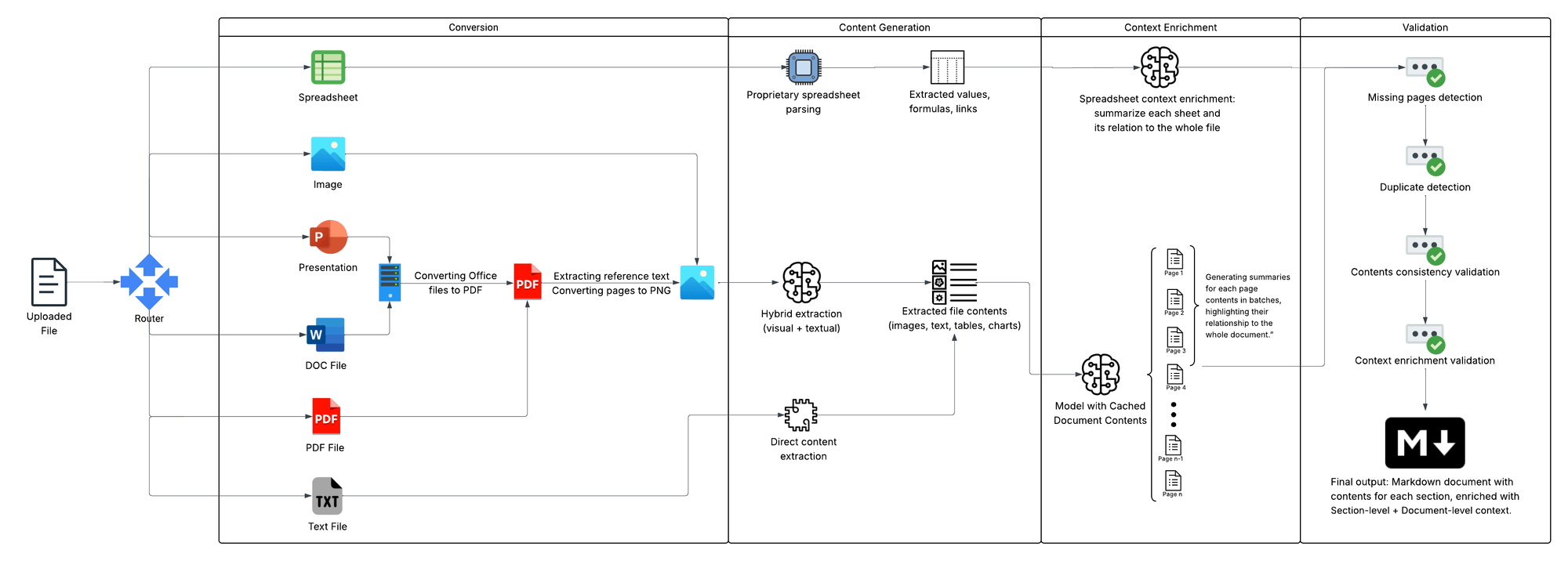
Desia automatically classifies and routes each file type (PDF, Word, Excel, image, and text) through its optimal processing path, ensuring every document is handled based on its actual internal structure and content, not just the file extension.
Documents are normalized into standardized intermediate representations. Office documents are converted into PDFs in isolated, resource-constrained environments to preserve layout and formatting:
This approach provides uniformity for downstream processing while preserving the structural and semantic integrity of each file type.
Documents are processed through an orchestration layer that coordinates multiple vision-language models. Each page is represented both as an image and as text, enabling models to capture layout, diagrams, tables, and written content in parallel. Processing begins in batches for efficiency and automatically falls back to page-level retries under rate limits or when quality thresholds are not met. Retry strategies apply progressive backoff and alternative processing paths to maintain throughput and reliability.
Extraction runs in parallel, combining visual and textual elements:
Both representations are merged into a single input, allowing the model to cross-reference them. This enables richer outputs, including descriptive analysis of charts, diagrams, and other visual elements. This allows Desia to interpret not just written content but also the charts, tables, and figures that are central to financial analysis. Crucially, Desia parsing solution also handles scanned documents, where traditional AI often fails.
Desia is built to handle various spreadsheets with precision. The files are processed using a dedicated pathway that maintains their inherent structure. Instead of flattening spreadsheets into PDFs, the parser preserves:
By preserving the logic behind the numbers, through ensuring accurate interpretation of spreadsheet semantics, Desia makes AI-powered due diligence and portfolio value creation more reliable and effective.
After parsing, every document passes through a context enrichment pipeline designed to generate document-level intelligence. This stage is a crucial step that ensures individual page outputs are interpreted in relation to the full document. The enrichment process uses a document-level cache to persist embeddings and analysis results across the entire file. The full document is first stored in cache, enabling global context to be referenced throughout subsequent steps. Pages are then processed in batches, where each page-level analysis incorporates both the page content and references to the global cached context. This design enables:
Extracted outputs undergo multi-level quality assurance. Visual and text-based results are cross-validated for consistency. Duplicate detection operates at both page and context levels, filtering out repeated phrases and sentences. Documents must meet configurable quality thresholds for completeness, coherence, and structural integrity. Failures trigger retries with adjusted strategies until acceptable results are achieved. The result is a cohesive, markdown-format, document-aware output where each page is not only parsed locally but also contextualized against the larger structure and narrative of the document.

Our large-scale natural language processing allows you to search, generate documents,and uncover answers to complex questions in minutes.


In Q3 2023, Company XYZ faced a major data breach, exposing customer information. The incident led to a 30% churn rate among enterprise clients over the next two months. Consequently, annual recurring revenue dropped from $30M to $23M by year-end 2023.

Revolutionize your firm's operations and join the leading institutions trusting Desia.

